Suspension Repair in Tallinn
It's no secret how much stress a vehicle's suspension endures. Given local road conditions, these loads increase significantly.
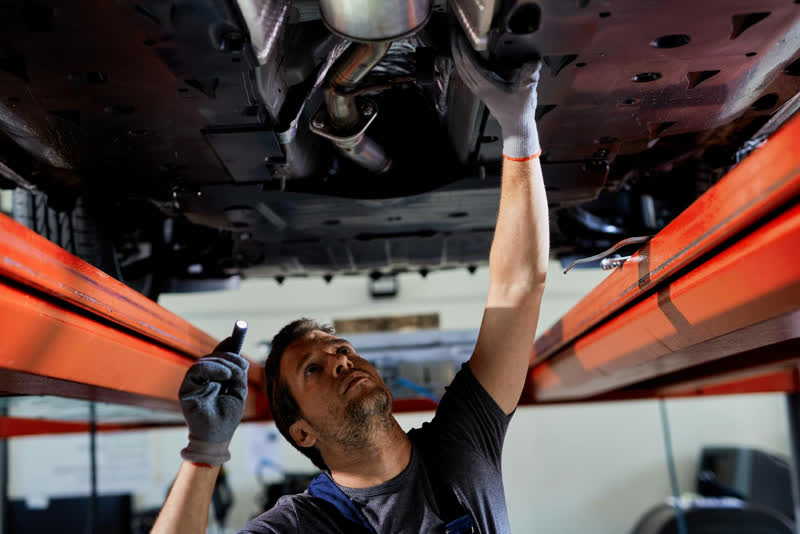
We always remind our clients that suspension repairs shouldn't wait until it starts knocking or bottoming out, nor should you wait for an accident. Routine diagnostics and preventive care are essential to saving time, money, and preserving your chassis.
When Should You Pay Attention to the Suspension?
Here are the most common indicators:
- Change in ride comfort (excessive body roll and swaying);
- Nose-diving when braking;
- Shock absorber leaks;
- Frequent bottoming-out on road bumps;
- Squeaks and unusual noises while driving.
Shock Absorber Replacement
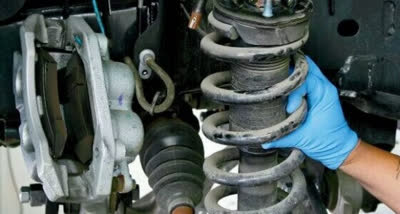
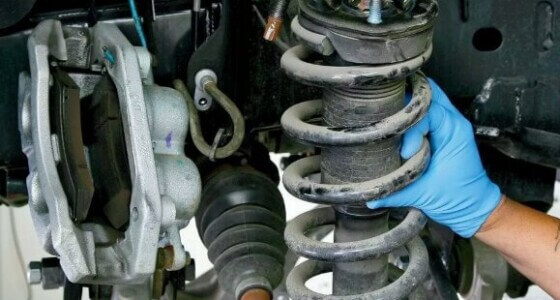
With faulty or low-quality shock absorbers, a car becomes unstable on roads and during turns. On rough roads, wheels can lose contact with the ground, leading to a loss of control. Furthermore, failed shocks eventually ruin the entire suspension system.
Strut mount bearings also require replacement. Inside the shock absorber are oil seals designed for up-and-down piston motion only, without rotation.

Ball Joint Replacement
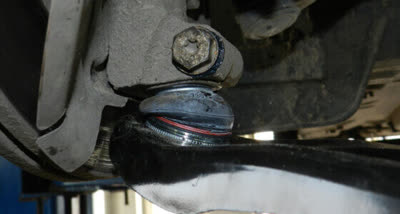
Ball joints form an essential structural part of the suspension system, connecting the control arm to the steering knuckle hub.
Unusual knocking at low speeds;
Steering wheel squeaks;
Vehicle drifting while driving;
Uneven tire wear.

Control Arm Repair and Replacement
A control arm is a single-piece structural element of a specific shape that connects the wheel to the vehicle body.
Squeaking, grinding, or knocking in the suspension during vertical movement;
Vehicle pulling away from a straight path;
Uneven tire wear.

Sway Bar Link and Bushing Replacement
Sway bar links are rigid rods that compensate for lateral loads on the suspension, attached via flexible end bushings.
Stabilizer failures are usually caused by worn flexible bushings, though bent or broken stabilizer bars can also occur.
The most distinct sign of a damaged stabilizer link is a rhythmic knocking sound in the suspension, particularly audible at low speeds (under 20 km/h).

Strut Mount Replacement
This unit consists of a rubber-to-metal structure with mounts, attaching the shock absorber to the body and absorbing impacts from bumps and potholes. Reasons for replacement:
Visible tears on the rubber portion;
Rubber peeling away from the metal;
Impact noises over rough roads;
Crunching or heavy clicking from slipping springs when turning the steering wheel.
Air Suspension Repair and Replacement
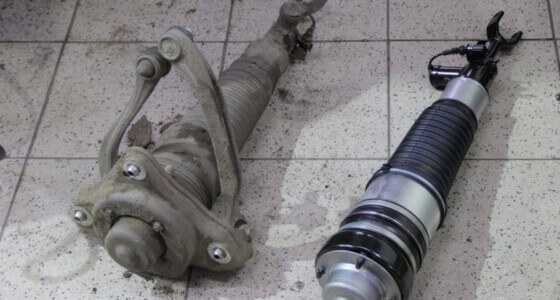
Air suspension replaces conventional shocks and springs with air bags. Its main tasks include:
Automatic body level maintenance;
Manual body height adjustment;
Speed-dependent automatic height adjustment.
If an air strut fails to perform these duties, it requires replacement.

Wheel Bearing Replacement
Wheel bearings feature a sealed design intended to last until near-complete wear, requiring no repacking of grease. Timely wheel bearing replacement is essential for road safety under heavy loads.
Humming noise that vanishes when stopped or turning;
Steering wheel vibration;
Axial wheel play;
Grinding sounds near the suspension and wheel connection;
Hub or hub cap feeling hot to the touch.

Bushing Replacement
Bushings (silent blocks) consist of two metal sleeves separated by a rubber or polyurethane insert, dampening vibrations between suspension components.
Reduced handling responsiveness (especially at high speeds);
Squeaks originating from the suspension;
Play in control arm and stabilizer connections;
Noticeable body lean during cornering;
Uneven tire wear due to misaligned arms and disrupted wheel alignment.