What is LPG Equipment?
LPG (Liquefied Petroleum Gas) equipment is supplementary equipment enabling storage and delivery of gaseous fuel to internal combustion engines (ICE).
Generation I Automotive LPG Systems
Generation I operates by regulating gas pressure leaving the reducer-vaporizer and mechanically metering fuel feed. These systems were installed on carbureted and single-point injection engines.
Generation I used both vacuum and electronic reducers (without lambda sensors) featuring traditional gas mixers.
The equipment kit contained vacuum or electronically controlled reducers.
Generation II LPG Systems
Generation II systems feature an electric reducer and electronic metering device relying on oxygen sensor (lambda) signals, throttle position sensors (TPS), and crankshaft speed sensors (RPM).
The gas ECU (lambda controller) processes these sensor signals to maintain stoichiometric gas-air mixtures across steady and transient engine states.
Generation III LPG Systems
In Generation III systems, an electronic control unit and metering distributor provide synchronized multi-point gas injection into intake manifolds via mechanical injectors.
The ECU relies on TPS, lambda, RPM, and MAP (manifold absolute pressure) sensors to adjust fuel feed.
Individual gas delivery to each cylinder uses mechanical injectors opened by line pressure.
Generation III gas ECUs generate internal fuel maps; however, stepper motor design limitations restrict rapid mixture corrections.
Generation IV LPG Systems
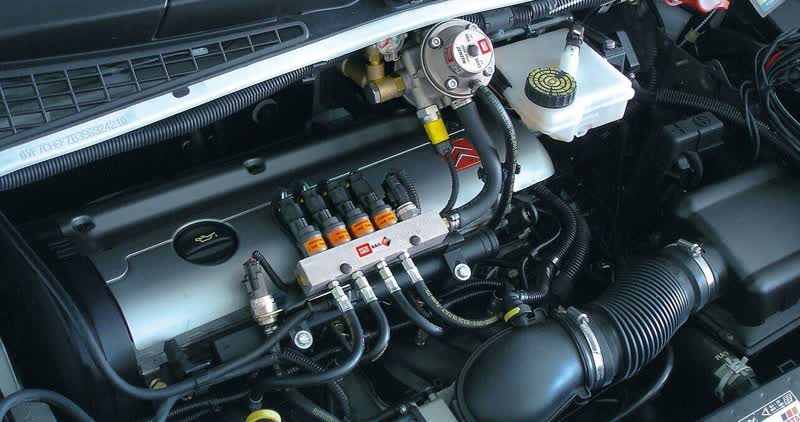
Utilizing electromagnetic injectors, Generation IV provides sequential or parallel gas injection. Operating principles differ through precise fuel metering placed adjacent to petrol injectors.
Electromagnetic gas injectors are regulated by a dedicated gas ECU (mirroring stock engine ECUs). The gas unit intercepts signals sent to petrol injectors, calculating corresponding gas pulse widths.
Calculations incorporate gas temp, gas pressure, reducer temp, and manifold vacuum. Gas injection is effectively managed using stock ECU signals.
Petrol supply shutoff is performed by the gas ECU interrupting petrol injector signals while emulating injector loads to prevent 'Injector Circuit Open' fault codes.
Generation IV is currently the most widespread and utilized LPG equipment type.
Generation IV+ LPG Systems
For example, BRC labels this system Direct Injection, engineered specifically for direct-injection engines. Direct injection architecture delivers small fuel pulses straight to spark plugs during idle, making gas operation inefficient at idle speeds.
The gas ECU differs from Generation IV by controlling petrol and gas injectors simultaneously. To protect petrol injectors, petrol flow is restricted rather than cut completely—resulting in up to 20% petrol and 80% gas mixture ratios.
Ease of Use
- Equipment operation is fully automated
- LPG refueling mirrors petrol refueling
- Minimal maintenance requirements
Simple Purchasing
- Payment via card, cash, or partner bank financing
- Installation possible within the week of booking
- Wide equipment selection covering diverse vehicle makes
We partner with top LPG manufacturers: Atiker, BRC Global Standards, STAG, Digitronic, OMVL.